THE EXPERIMENT
Ideas. Dreams. Momentum."Welcome to the origin point. This is my digital studio—a place for the experiments that define my practice.The "Living Laboratory" (Most Personal)
THE INCUBATOR
Where Dreams Breathe and Ideas Take Form
"Welcome to my private studio—the silent heart of the creative process. This page is a dedicated space for experiments, raw thoughts, and the projects that wake me up at night. Here, the boundaries of scale and material are tested, and the 'ghosts' of past concepts are reborn into monumental futures. You are entering the workspace of the unfinished and the uninhibited. This is where the story begins before the bronze is even cast."
THE ARCHITECT OF THE UNSEEN
From the Essential to the Ethereal: The Rebirth of E Okoro Sculpture
"An artist is a dreamer consenting to occupy a certain space." — Max Ernst
The Long Awakening
There is a specific kind of artist who does not work with the clock, but with the tide. I am often asked why it takes me so long to be satisfied with a single idea. I sleep on it. I obsess over it. I allow it to elude me, haunting the periphery of my mind until it feels less like a project and more like a psychological defence. I have abandoned works for decades, leaving them to gather dust in the corners of my memory.
But then, a change in the weather—a dry heat, a sudden rain, or the mere tactile "touch" of a half-forgotten Marquette—sparks that same idea back to life. In the world of high art, we call this The Slow Burn of the Visionary. Like Alberto Giacometti, who famously reduced his figures until they almost disappeared into the air, or Auguste Rodin, who would revisit the same torso for thirty years to find its true soul, I believe that a work is only ready when it has survived the artist’s own doubt.
The Departure: Why Abstract?
My transition toward the abstract—the "Ghost Train" style—is not a departure from the human form, but a journey deeper into it. If my earlier works like Okefo or The Young Bride were about the physical resilience of the body, these new abstract silhouettes are about the residue of the spirit.
Abstract art, at its highest calibre, is the language of the invisible. When I look at the work of innovators like Henry Moore or the bold, structural defiance of Eduardo Chillida, I see that they weren't just carving stone or casting bronze; they were carving space itself.
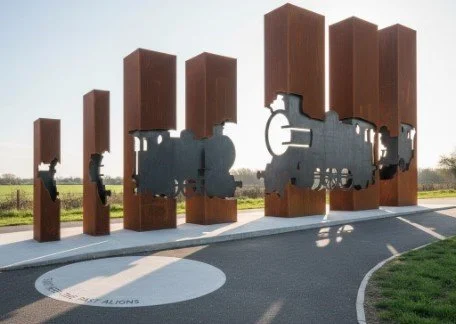
The "Ghost Train" direction represents the momentum of a life travelled. It is the blur of history, the speed of memory, and the "jibs" of an emotion that can no longer be contained by a nose, an eye, or a limb. It is the human essence caught in mid-motion.
Reinventing the Pillar
To move in this direction is to reinvent myself. I am no longer just a storyteller of the Nigerian Delta; I am an architect of the void. By paring down even further—moving past the figurative into the rhythmic and the ethereal—I am seeking the Universal Frequency.
This is why I return to my "failed" or "abandoned" ideas. Those projects weren't dead; they were simply waiting for me to become the artist capable of finishing them. A touch of the hand in 2025 brings back a spark from 2004, but with a new weight, a new height, and a new clarity.
The Philosophy of the Studio
In this new era, my studio has become a laboratory for these "dreams in progress." Whether it is a 4-meter bronze or a small, haunting abstract study, the goal remains the same: to stop the viewer in their tracks. To make them feel the "Ghost Train" as it passes through their own history.
I am a "Perpetual Returnist"—an artist who finds the future by refusing to let go of the past until it has surrendered its secrets. This is not just sculpture; it is the physical evidence of a long-form meditation.
Artist Insight: Why "Ghost Train"?
"The Ghost Train is the energy of what remains when the body is gone. It is the streak of light left behind by a fast-moving thought. It is the struggle to perform, finally distilled into a single, soaring line of focus." — Emmanuel Okoro
Project Narration: The Vessel (2025 Rebirth)
(Tone: Profound, authoritative, evocative. Fuelled by blood and the chaos of a broken world.)
We are done sculpting human forms clutching futile offerings. Our hands are empty. "The Vessel" is no longer about exchange; it is about absolute, terrifying reception.
This is not a memorial to the dead of the past; it is a sentinel witnessing the slow death of our present civility. We are capturing the "wild energy" of 2007—that upward, raw, animalistic surge to escape, to be free—but we have crushed it. We have forced that explosive desperation into a monumental, monolithic column of dark bronze resin, 400cm high. The energy is there, trapped, vibrating, a constant silent scream of compression.
But the column itself is not whole. It is defined by its fracture. A massive, precise aperture has been punched through its very core. This is not a clean void; it is a violent passage, its internal surfaces a geode of petrified Nigeria Delta root wood and volcanic rock. It looks as if the Earth itself has been fragmented. It is a time capsule of our failures—a gateway that holds the memories we try to ignore: the entire catalog of war, the statistics of mayhem, the stench of failure, the "death and mayhem" that we now use as fuel for creation.
This central, open channel is the offering. It is our absolute vulnerability. It stands as a prayer for focus amid the global noise. It asks nothing of you. It does not wait for a gift. It simply receives. It is an architecture of reception, waiting for the current chaotic tide to recede, distilling the mayhem into stillness. We are creating a record for the future so they may never again revisit the human behavior that created this need for containment.
This is not a ghost. This is an engine of prayer. It is not movement; it is stillness. We are sculpting the absence that allows the spirit to be filled.
We do not look back. We are done.
Edition Structuring: "The Vessel"
I propose a tiered structure that allows this message to infiltrate distinct spaces, scaling from an intimate study to an inescapable monumental presence.
1. The Collector’s Passage: The Receptacle
Dimensions: 110 cm H x 25 cm W x 20 cm D
Medium: Solid Cast Bronze, deeply patinated 'scorched earth' black with highly polished interior surfaces within the passage.
Edition Size: Limited Edition of 12 (+ 1 AP).
Purpose: The immediate, tactile encounter. Focus is on the contrast between the rough exterior and the polished, almost mirrored 'receptive' core.
2. The Monumental Column: The Sentinel
Dimensions: 400 cm H (4 Meters) x 80 cm W x 60 cm D
Medium: Bronze Resin mixed with iron and copper dust, allowing for subtle weeping oxidation (reds, greens), connecting the monument to elemental rebirth.
Edition Size: Limited Edition of 9 (+ 1 AP).
Purpose: Internal architectural focal points. Museum foyers or corporate sanctuaries. This piece commands the vertical space, transforming the void within it into a physical, historical force.
3. The Grand Architectural: The Land Vessel
Dimensions: 600 cm H (6 Meters) x 120 cm W x 90 cm D
Medium: Monolithic Cast Bronze, extreme texture (referencing petrified, fragmented Delta root wood) with highly polished inner channels that align with the specific sky (e.g., dawn/dusk alignment) of the installation site.
Edition Size: Limited Edition of 3 (Reserved for Public Commissions).
Purpose: External landscape placement. The work acts as a true sentinel, focusing the environmental light into that central channel, creating a physical passage for the mind, where the specific chaos of the site is distilled into a universal stillness.
'GHOST TRAIN- 2011 by Emmanuel Okoro

